


Wacky Wednesday (#1): Ram's Horn Squid

Today marks the first instalment of a blog segment known as ‘Wacky Wednesday’s’. Each week we feature a new bizarre, cool, wacky creature and learn about where it’s from, how it interacts in the environment and its awesome adaptations.
Last weekend scientists discovered a pinnacle of coral taller than the Empire State Building in the Great Barrier Reef. Within this newly found deepwater ecosystem a special squid species, known as the Ram’s Horn Squid, was caught on film for the first time.
Quick facts:
Scientific name: Spirula spirula
Geographic location: deepwater subtropical seas (e.g. coast of New Zealand and Great Barrier Reef)
Distinguishing feature: shell in the shape of a ram’s horn
Conservation status: not threatened

Illustration of a Ram's Horn Squid upside down with its photophore facing up. By Rachel Caauwe.
Named after its distinctive ram’s horn-shaped shell, this squid is a remarkable example of how life functions in deepwater ecosystems. These little guys are approximately 7cm long and can be found in water 10 to 1000 metres deep. Research published by Cambridge University Press found that these squids have a diurnal (24 hour) cycle in which they travel towards the surface during night hours (100-150m) and then turn around and reach their deepest depths (1000 m) at midday. There are many proposed theories for this but the most commonly accepted explanations seem to be predator avoidance and access to food. These diurnal movement patterns are common across many marine organisms and are considered the world’s largest biomass migration phenomenon.
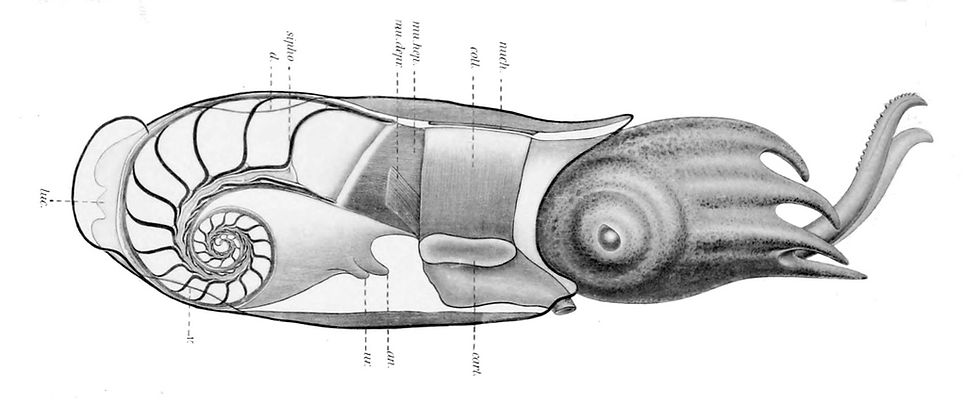
By Ewald Rübsamen, 1910.
Capturing these little guys on film was an important step in understanding how they move and orient themselves. Until seeing them live in their natural habitat, scientists were unsure whether they swam with their heads up or down! They assumed that they would swim head down, with their gas-filled bottom-up, but video footage confirms it's the opposite! Swimming head up and coiled shell down helps them maintain buoyancy. This is an impressive feat of balance! Imagine trying to stand on a balloon underwater. Not easy when you consider how their main mechanism for avoiding predators is to stay really still!
Watch this footage of the Ram's Horn Squid and wait till the end to see it jet into the inky depths!
Ram’s horn squid also produce a little green light which comes from a light-producing organ known as a ‘photophore’. This light shines from their lower half and is therefore sometimes called the ‘tail light squid’. The purpose of this light is unknown. Zoologist Dr Vechhione says to the New York Times that “this is neither common nor does it make sense”. Not only does creating the light require significant energy, but it could also attract predators. A mystery waiting to be solved!
To have your favourite wacky animal featured on the blog, comment their species name and why you like them below!


Who doesn't love a eukaryotic organism like a Slime Mould...fascinating...!
If extinct animals are on the table, anything from the Cambrian Explosion should make the list
Or pangolins
You should write about water bears
Or you should write about the xiphactinus