


Trilobite queues and tridents (WW #3)

Updated: Dec 11, 2020
What was life like 500 million years ago? Dinosaurs didn’t exist yet, plants didn’t exist on land and there certainly weren’t iPhones.
Although it sounds kind of boring, Earth was undergoing a biological metamorphosis. And this week’s critter was an important part of this historic moment in time, known as the Cambrian explosion. It’s the trilobite.

Quick Facts:
Scientific name: Trilobita (meaning ‘three lobes’ based on their body structure)
Geographic location: inshore waters and deep-sea, worldwide
Distinguishing feature: large, segmented body with trident or pitchfork
Conservation status: Extinct
Trilobites are considered one of the planet's first invertebrates with an exoskeleton, known as an arthropod. With over 20,000 species currently identified from fossil remains, there is a remarkable range of diversity in body shape, abilities, size, and fossil characteristics.
Since trilobites became extinct 252 million years ago, our understanding of them must rely on what we can deduce from fossil records. The Cambrian explosion was a significant event in biological evolution, and part of our fascination for the trilobite comes from the fact that we have an abundance of fossils to study from that period. Before then, most forms of life were ‘soft-bodied’, meaning their bodies decomposed and therefore not preserved in the geological record. Our understanding of life before the Cambrian is primarily based on fossilised tracks. Trilobites are our first opportunity to get up close and personal with ancient life.
To understand their behaviour and role in the ecosystem, we must first understand how their body is organised. Trilobites are composed of three body segments (cephalon head, thorax mid-section, and pygidium rear) and three lobes (two sides and a centre axis). Body size changes from species to species however they typically range from 1 millimetre as juveniles, up to 70 cm long in the largest found specimen.

Trilobites are able to roll into a ball, presumably for protection against predators, using their three segments to coil up so that only their pointy exoskeleton is exposed. This is considered a desirable trait as talented individuals were more frequently chosen to reproduce. Some species also had extra spikes, spears and tridents which are assumed to help them attack prey. Olenoides have tough spines on their legs which we think help them rip soft-bodied organism.
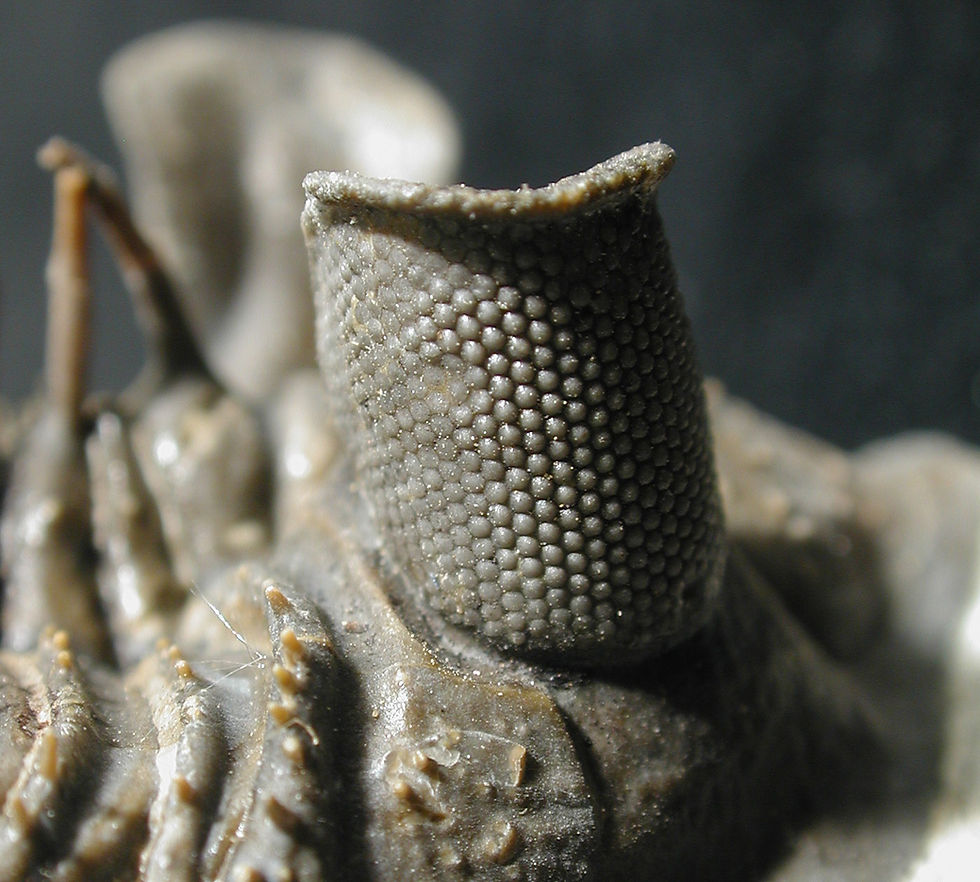
Trilobite eyes are considered one of the first examples of compound eyes in evolutionary history. Compound eyes are a collection of lenses which can give the animal a wider range of view. Shrimp, flies and bees are modern examples of animals with compound eyes. The trilobite species Erbenochile had a bizarre adaptation where their compound eye is in the shape of a tower! Despite these complex visual organs, they couldn't see very well and instead, sensed changes in light conditions.
Current trilobite research is now diving into how they interacted with their environment, and each other. Climate change is hypothesised to be the main driver of evolution in these critters since the enormous range of diversity indicates that each species was perfectly adapted to its environment's temperature, oxygen concentration and turbulence. The species-specific tridents and pitchforks are assumed to be either for males jousting or a unique hunting strategy. This indicates that trilobites were likely coordinated in groups.
A recent fossil discovery shows trilobites neatly lined up in a trail. This has excited scientists who contemplate the social and group behaviours these animals may have had. Theories of where and why they were marching include travelling to spawning grounds or retreating from harsh environmental conditions. Click here, to see a photo!
Another wacky critter mystery! Where do you think they were going, and why? Put your theories in the comments below...


Wow! It's incredible to know more about our planets's biological evolution! About the lined up trail I have no idea, but if would suggest, I'll say they're cooperating in something!! Nice postz thank you for sharing!!