


Face mask phobia: where did it come from?

Don’t you think it’s starting to feel like we’re living in an episode of Doctor Who? The number of masked people in the supermarket, service station, and carpark is growing. Some may say this is reassuring, whilst for others there remains an underlying sense of fear and unease. Where did this aversion come from? And, are face masks helping or hindering our battle against COVID-19?
In 1598, a young, Frenchman named Charles de L’Orme graduated from the University of Montpellier. Acknowledged as a gifted scientist, and son of a famous medical doctor, Charles was well-respected and appreciated for his research. His work featured topics such as “Should one use the same remedies for lovers as are used for the insane?” and “Are the lives of kings, princes and great men less exposed to disease and longer than common people and peasants”. Not only was this work relevant and innovative, but also commented on differences in class and sex, and the nature of health and disease. People noted his elegant features, clear voice and remarkable memory and would see him live to the age of 94, claiming that “He who drinks will live more”. His success led him to quickly climb the academic ranks to become doctor to the French Kings Henry IV, Louis XIII and Louis XIV. His work was prestigious and highly regarded. He was not however, working in an era that was easy for doctors. Foreign and elusive diseases ravaged the population.
In the latter half of his life, Charles worked on treating those with the bubonic plague. Oldest known evidence suggests the plague originated in the Late Bronze age (almost 4000 years ago) and resulted in three major pandemics, including the ‘Black Death’ in the 1300’s. The mortality rate was estimated to be 20% in town centres, resulting in millions of deaths.

Symptoms included chills, seizures, gangrene, and swollen lymph nodes named ‘buboes’ (I’ll spare you the imagery). Medieval doctors suspected the disease could be transmitted through the air, however the main mode of spread was via infected fleas carried by rats.
In response to the gruesome symptoms, rapid spread and centuries of death Charles engineered a uniform for doctor’s protection when treating patients. His suspicions about the disease being airborne led him to design a waxy black cape, boots, cane, and mask. However, this was no ordinary mask, alarmingly different to the colourful masks occasionally worn as a fashion statement today.
With a beak and glass spectacles, the full-face mask was terrifying. The 15cm beak was stuffed with aromatic herbs and spices such as lavender, cinnamon, honey and another 90 or so herbs, all theorised to combat airborne infections. The outfit created a remarkable, terrifying figure which quickly became a physical embodiment of the disease. These men were known as ‘plague doctors’.
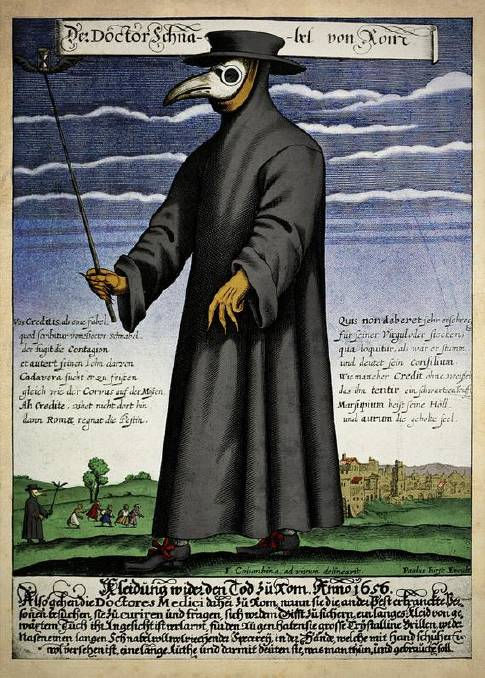
Many of these men were not trained in medicine at all and were unsuccessful at curing people of the disease.
Today, wearing a mask remains as essential as 1500 years ago however, public perceptions are mixed. Similar to the fearful attitude shaped by de L’Orme’s mask in the Medieval era, there is a general sense of objection and fear. We suspect this is attributed to a lack of cultural acceptance, and misconceptions surrounding their effectiveness. Research has determined that to prevent COVID-19, a facemask must be able to trap particles between 10 nanometers and 10 micrometers, (roughly the same width as a strand of DNA!). If the mask doesn’t fit properly, efficiency may decrease by up to 60%.
As I’m writing this, wearing a face covering is mandatory in Melbourne. Sydneysiders are also quickly adopting them. As a result, buying medical grade face masks is growing increasingly difficult, and expensive. So how effective are homemade cloth ones? Science suggests that whilst cloth masks can reduce the spread of microorganisms from the wearer, surgical masks can be up to three times more effective. This demonstrates that whilst medically approved masks are ideal, as supplies run low and demand increases, we must become innovative and resourceful with mask production and use.
Our perception and acceptance of face masks also remains relevant as those who live in areas where mask wearing is not mandatory, have an ethical choice to make. Media conveys a mixed message about their importance, and for many Australians, wearing a mask is jarring and uncomfortable. We, as individuals, are left to decide whether the risks outweigh the discomfort. And here lies the importance of trustworthy science and media, to help us make informed decisions.
Going forth, we must recall how this has happened before. Knowledge of infectious diseases has come so far and we have learnt so much from Charles and his plague doctors. Facemasks no longer have beaks and doctors no longer prod people with canes. Today, our choice to wear a mask can symbolise the fight for a healthy community and future.
References
Davies, A., Thompson, K. A., Giri, K., Kafatos, G., Walker, J., & Bennett, A. (2013). Testing the efficacy of homemade masks: would they protect in an influenza pandemic?. Disaster medicine and public health preparedness, 7(4), 413–418. https://doi.org/10.1017/dmp.2013.43
Gonzalez, R., & Miller, V. (2016). A Deadly Path: Bacterial Spread During Bubonic Plague. Trends in Microbiology, 24(4), 239–241. https://doi.org/10.1016/j.tim.2016.01.010
Konda, A., Prakash, A., Moss, G. A., Schmoldt, M., Grant, G. D., & Guha, S. (2020). Aerosol Filtration Efficiency of Common Fabrics Used in Respiratory Cloth Masks. ACS nano, 14(5), 6339–6347. https://doi.org/10.1021/acsnano.0c03252
Mussap, C. (2019). The Plague Doctor of Venice. Internal Medicine Journal, 49(5), 671–676. https://doi.org/10.1111/imj.14285
Thomson S. C. (1926). Antimonyall Cupps: Pocula Emetica or Calices Vomitorii. Proceedings of the Royal Society of Medicine, 19(Sect Hist Med), 2–128.
Wear, A. (2015). Making us as cruel as dogs: plague in 16th and 17th century England. The Lancet, 385(9986), 2456–2457. https://doi.org/10.1016/S0140-6736(15)61129-1


Comments