


Beth Eyre: Brain health, researching Alzheimer's and getting published

Beth Eyre, AKA @BethsBrainBites, has quickly become a familiar face in the Instagram science community. With her snappy and informative videos, she educates the masses about brain anatomy and her PhD research on Alzheimer's.
Here we take a deep dive into how she started her science career, the details of her PhD research, and how she stays sane amongst all the craziness. She's a joy to learn from and I can't wait for you to read her brain and productivity tips and tricks!
Let’s start with your origin story. What inspired you to go into science and why did you decide to learn about psychology and neuroscience?
For a long time, I couldn’t quite pinpoint why I was so fascinated by the brain – as a child I remember being intrigued by how things worked, especially the human body. At secondary school I remember being the only person in my class to be awarded the gold biology Olympiad award (which everyone, including myself was quite shocked at). In year 10 I remember going to an open evening, hearing about the psychology GCSE and knowing deep down that I had to choose it.
But I still didn’t know where that drive to understand people and the brain came from until a conversation during my MSc. Myself and a student were talking about brain and spinal tumours and I shared with her that my dad sadly died from a brain tumour when I was 11. And she turned to me and said, well it makes so much sense why you want to study the brain – and then something clicked, the reason I was so fascinated by the brain was because of my dad, because of his cancer and how it robbed him of his life and changed my life forever. So yeah, at the root of it I’d probably say my dad was my inspiration.
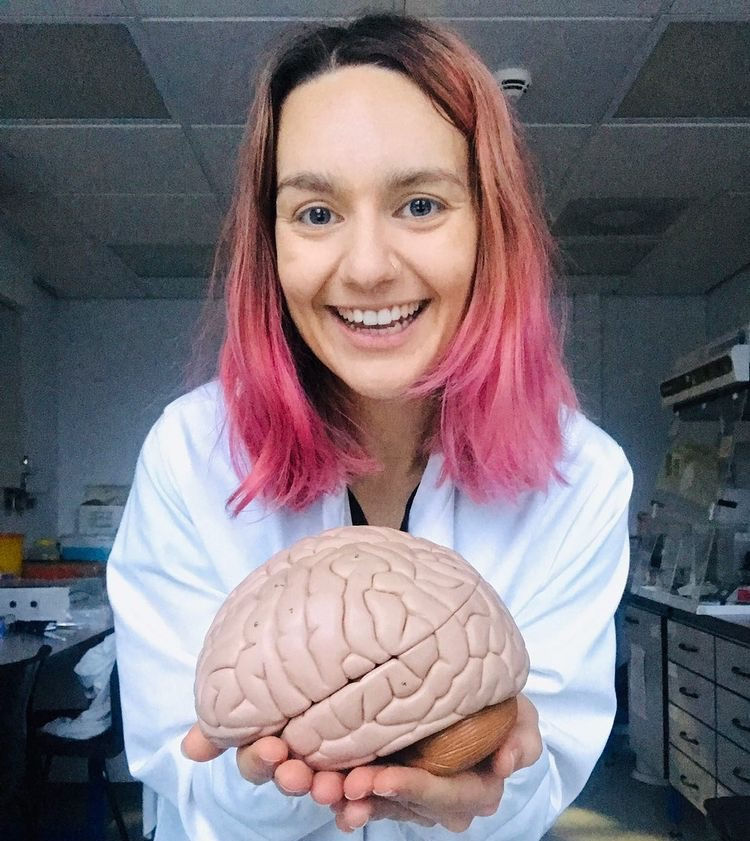
You’ve just entered your second year of your PhD! Congratulations! What are you learning and researching?
My research is looking at brain health in a model of Alzheimer’s disease and in a mixed model of Alzheimer’s and atherosclerosis. My research investigates if there are changes in blood oxygenation and neural activity in these different diseases. These measures allow me to investigate neurovascular coupling in Alzheimer’s disease. This is the relationship between a neuron in the brain firing and an increase in blood flow which ensures that neurons can get the energy they need to keep functioning.
My PhD is in the UK and as our PhDs are only 3-4 years we don’t have to take certain classes (well I don’t anyway). We have this time to focus on research, which is really cool!
In my first year I research the literature and write my literature review. This means that I read loads of papers about Alzheimer’s disease, the brain, the model of Alzheimer’s I’m using and I note what we already know. I applied for a project that was already proposed which meant I didn’t have to come up with the whole concept myself but, by reading the literature you can find where there are gaps. These gaps tell us what we need to learn more about and you can then address these gaps in your research.

One of the gaps in the literature I’m going to investigate is looking at two diseases at once (we call this comorbidity). There isn’t much research looking at how Alzheimer’s is impacted by other diseases, so to follow on from previous research done in my lab I’m also going to be looking at how more than one disease can impact neurovascular coupling in Alzheimer’s.
Your first year is also for learning how to use new techniques and equipment that you’ll be using during your PhD for finding answers to your research questions and testing your hypotheses. I’m currently learning how to measure blood oxygenation using a method called 2D-Optical imaging spectroscopy (2D-OIS). Hopefully, I’ll get to learn how to use a two-photon microscope to look at individual cells and blood vessels within the brain. I’m really excited about learning how to stain brain cells and visualise them – we call this immunohistochemistry. I’ll be using this method to look at the number of amyloid beta plaques we find in the brains and also to look at the health of other brain cells.
The end of your first year and most of your second year is all about doing the experiments (well this is how it’s worked out for me anyway). Part of a PhD is that you have to produce some original research. You’ll do lots of experiments to answer the research questions you proposed in your literature review and test the hypotheses you produced. Hopefully, these experiments will lead to some original findings.
The final year is usually for getting extra data you may need. When doing experiments, you may come across something interesting that you thought needed another experiment to investigate. And then the write-up period begins. During a PhD you have to produce a doctoral thesis/dissertation. This is basically the write up of all the experiments you did in your PhD. Once you’ve written this, you submit it and then you have something called a viva – which is where you have to defend your findings to experts in the field.
During your PhD you literally learn SO much, a great way to describe a PhD is a training programme to become a scientist, so right now I’m learning how to become a scientist!
What was the path to starting a PhD like, and what have you learnt in your first year of research?
I’ve always known that I loved studying and learning new things but I never really knew what a career in science would look like. What’s important to remember is that everyone’s path to a PhD is different – and that’s totally okay and actually, how it should be. For me, I went to university to study psychology, studied in Australia for a year and got to travel in my long summer off (probably the best year of my life).
I finished university and realised I wasn’t too sure what I wanted to do. So, instead of rushing into things I took a year out of education, I worked as a boating instructor at a camp in America and then came back to the UK and worked as a teaching assistant working with young people with special educational needs. The job was great but I missed learning and studying so much, so I applied for a masters. I knew from my psychology degree that I preferred the more neuroscience-based modules so decided to start and specialise my knowledge by doing a masters in cognitive neuroscience and human neuroimaging. Masters was amazing. I got to learn all about the brain, I even got to do brain dissection classes (which is where it was solidified for me that I wanted to work/research the brain) and this is when I started looking for PhDs.
Prior to applying to the masters I applied for a couple of PhDs but, sadly didn’t get to interview due to a lack of experience – so one of the reasons I decided to do a masters was to allow me to hopefully get onto a PhD.
PhD applications can be difficult, as you put so much time into them and sometimes either don’t hear back or you just get rejection after rejection. [I learnt that] rejection is normal. Most people don’t get accepted to their first PhD application. Anyway, a fantastic PhD opportunity came up at the university of Sheffield researching neurovascular function in Alzheimer’s (this is where I was doing my masters). I applied, got an interview and here I now am – a second year PhD student!
The most important thing I’ve learnt during my first year is how to not feel guilty for taking time off from my work. A PhD can take over your life if you let it. It’s easy to go home and instead of switching off start thinking about all the experiments you need to do, and what certain results mean or even be thinking about what the future holds for you. BUT I’ve found that if you aren’t strict with yourself this can be very overwhelming.
During my undergrad and masters I would feel so guilty for not revising in my spare time (even though I was working and revising for many hours each day) but during my PhD I realised this would be counterproductive. It’s important to switch off and allow your brain to rest. Academia can be tiring and mentally draining and your brain needs a break. So how did I do this? How do I not feel guilty for taking time off and not thinking about work?
To be honest I can’t really give you a straight answer, a lot of it was when I did take time off and I noticed I was feeling guilty or if my brain was telling me that I should be doing work I acknowledged the thought and challenged it. After doing this continually for a couple of months I honestly don’t feel guilty for taking my weekends and evenings off. I value my wellbeing and as much as I love my PhD I do not want it to harm my mental wellbeing.

Why is your research important?
I previously said that I research the relationship between neurons firing and an increase in blood flow to that same brain region in Alzheimer’s models (neurovascular coupling). But why is it important to investigate this? Sadly, in the UK there are approximately 850,000 people living with dementia, and Alzheimer’s disease is the most common cause of dementia. There are also no real therapies/ treatments for Alzheimer’s right now, so scientists are researching as much as they can to find out how Alzheimer’s is caused, how it impacts the brain and blood flow and how it impacts neurons and other cells within the brain in order to one day help find some therapies that can hopefully stop the disease in its tracks.
What do you like to do when you aren’t working on your PhD?
One of the things I was looking forward to about doing my PhD was that I finally got paid to study and do my research – this meant that I didn’t have to have part-time jobs anymore and the jobs I did want to do could benefit my research career.
One of the most interesting things I’ve done during my PhD is teaching neuroanatomy – I get paid to teach brain dissection classes! During a PhD there is also a lot of opportunity to do outreach/public engagement so this is either where you do activities to get young people excited about science or you engage with the public and explain your research.
I’ve done some great outreach, including teaching at the elephant group virtual summer school, where I gave some academic sessions about Alzheimer’s disease and I’m also a Brilliant Club tutor. This is an amazing charity that gets talented young people from under-represented backgrounds into highly selective universities; for this I go into schools and teach groups of young people all about my research and at the end they have to produce a piece of work. They get the chance to go to a university and have a graduation – the programme aims to give them some of the skills that will help them at university. Unfortunately, due to COVID, my placement was cancelled. I’m really excited to apply for another placement.
I’ve also recently been asked to start blogging on a monthly basis for a dementia researcher – a network for early career researchers. I’ve never blogged before so I’m excited to see how it goes. Plus, the website is a great way to interact with other early-career scientists who also investigate dementia.
Hobbies are so important during a PhD. When I think about it, I never really had hobbies whilst at university or even at school. I’d hang out with my friends but I never had a real hobby. So, this year I started going to pole classes. I absolutely love it, it’s great to learn a new skill and get fit at the same time. I also find it a fantastic way to stop thinking about my research and really take some time for myself.
You recently became a published scientist. I think another congratulations is in order! What was that experience like, and did you learn anything that will help you publish more work in the future?
Thanks so much! I remember being at university and reading my first ever journal paper and thinking, how do people manage to get published? I can now join that club. I’m not the lead author (that will be my next milestone) but I am one of the authors. As the paper was a review it means that I researched the literature and reviewed what I found. It’s something really positive that came out of lockdown.
If I’m honest I’ve always had a thing about my writing. I never thought I was any good as I never got fantastic scores at university on essays (I always preferred exams) but helping write this review and seeing it get published has really helped with my writing confidence. If any of you out there worry about your writing the best advice I can give is to just practise, write from the get-go and your confidence will improve.

By getting some writing published it also meant I was able to observe the publishing process - which in academia is very strange. Did you know that scientists actually pay to have their work published? THEY DO NOT GET PAID FOR IT.
You submit your work to a journal, they tell you if it meets their requirements, then it’s peer-reviewed. This means that at least two other scientists read through it and comment on it. From here it can either be accepted without revision, which means it can be published straight away. Or, you can be told to revise and resubmit. This means that the reviewers have comments and may want things added or taken out. Or, it can be rejected (this can occur even before it’s reviewed).
The publishing process is definitely something we all have to learn in academia as it’s nothing like I expected it would be. Hopefully, some of my PhD work will get published at some point. Watch this space!
What can we do day-to-day to look after our brain?
I’m not a medical doctor, so I can’t give advice, but as a scientist, there are definitely some things that we know impact brain health and there are certain things individuals can do that may benefit their brain.
Sleep. Getting enough sleep has been shown to be important for healthy brain function. I personally feel like there is nothing worse than having a poor night’s sleep, it makes me feel groggy, grumpy and glum. Sleep is also super important for thinking and memory consolidation, so I try and get 7-8 hours sleep a night.
Diet. I’m sure many of you have heard this before but your brain and body are linked so, your diet can really impact your brain health. This is why it’s important to have a healthy diet, don’t have too much salt, eat your vegetables, don’t each too much saturated fat/processed foods etc. Hypertension, which is high blood pressure can be caused by eating too much salt. High blood pressure has been linked to something called small vessel disease in the brain. This means that the tiny vessels in the brain become damaged, leading to certain parts of your brain not getting the oxygen and food (that they get from the blood) to function correctly. An unhealthy diet can also lead to atherosclerosis – this is where fat builds up in the inside of arteries. This build-up of fat can reduce the blood flow to your heart and potentially your brain, and can lead to either a heart attack or stroke.

Exercise. Regular exercise has been shown to be important for your mental health. Some studies have shown that exercise can reduce feelings of anxiety, depression and negative mood. Plus, exercise improves your cardiovascular fitness (your heart health), which we know is important for brain health.
From my personal experience, something I believe can keep your ‘mind healthy’ (it has certainly helped me) is by being kind to yourself. Be kind to your mind. Your thoughts can be very powerful and if you aren’t nice to yourself this can impact your self-esteem, your confidence and wellbeing. So, remember to be kind to yourself. You’re doing a great job!
What are your productivity tips and hacks for young researchers?
Routine and structure!
For me, the best thing I could do when studying at university was to treat my degree like my job. I would only work between 8 and 5 and I’d schedule in one or two hour blocks for different subjects, making sure I took short breaks every hour.
Not feeling productive?
Sometimes when I’m feeling VERY unproductive, or if I’m having an off day (which we all have) I take the whole day off. I find that by taking the day to myself, doing some self-care, reading a book or watching Netflix, the next day I’m much more productive. If the idea of taking the whole day off is frightening then try to do some small tasks on your to-do lists such as sending emails or planning the week ahead.
Completed task lists.
One thing I find very helpful for my productivity is writing down all the tasks I’ve done that day before I go home. I literally write down everything I’ve done – even emails I’ve sent. This way, I have a record of all the things I’ve achieved every day, week or month. As a PhD project is so big sometimes you can feel like you aren’t really accomplishing much, by writing these lists at the end of the day it’s a visual representation of all the things I’ve achieved, which helps me feel more productive.

Why do you think it is important to educate young people about science, and what is the best way to inspire them?
Young people are the future of science! It’s important we get them interested in science and let them know that you can actually have a job as a scientist. If we don’t get young people interested there will be a huge loss of talent in science. I was never aware that you can have a job as a scientist, so I think it’s really important that we’re transparent and honest about what it means to be a scientist.
There are so many different types of scientists, so there’s a fit for everybody. A scientist is someone who uses the scientific method, makes hypotheses and designs experiments. For example, data scientists, work with lots of data, and analyse huge data sets to test their hypotheses. Wet lab scientists may use human tissue or stem cells to test their hypotheses, and psychological scientists design experiments that people take part in, in order to learn more about human behaviour
I want young people to realise that anyone can be a scientist and that science is for everyone. You don’t need to be a certain gender, or from a certain area or belong to a certain ethnicity. Science needs the opinions and input of people from all walks of life – this helps create new ideas and helps us think about things from different points of view.
For me, one of the best things I’ve done since beginning my PhD is creating my Instagram page, @bethsbrainbites. I think using platforms like Instagram is a great way to engage the next generation of scientists. It allows me to give large numbers of people a real insight into the daily life of a PhD student. It gives me a creative way to tell people about the brain and my own research and also allows me to interact with people and be a role model, showing that science is for us all.
What’s on the horizon for Beth’s Brain Bites?!
As I’ve been super busy with my experiments lately, I’ve struggled to find time to think about anything new for @bethsbrainbites. BUT, do not fear as the account is not going anywhere. I’m going to continue posting when I can about life as a PhD student, about the brain and my research. I’ve met some amazing people through my account and I hope to keep showing people what life is like as a PhD student and that science is for all!

To receive more from Beth and follow her research journey, check out her Instagram here, and read her published paper here.
Who would you like to learn about next? Is there a particular field of science you're interested in? Comment below!

Comments